
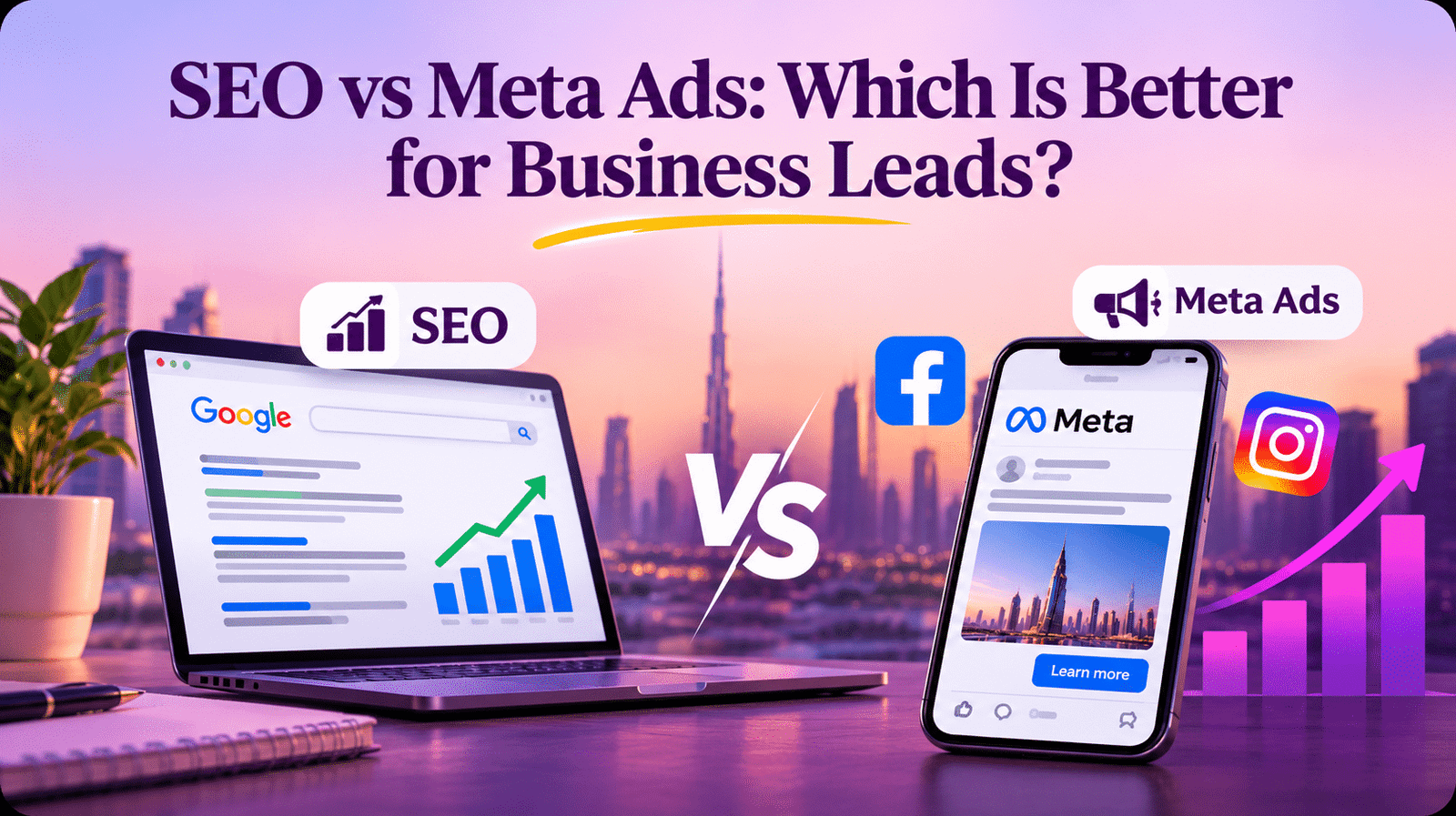
SEO vs Meta Ads: Which Is Better for Business Leads?
Imagine you own a business and need more customers. You start investing in Meta Ads, generate some inquiries, and expect sales to grow. Initially, things look promising. But when you pause your campaigns, the inquiries slow down. Your business is getting attention, yet you feel like you must keep paying to maintain it. Now you start wondering: Is SEO still worth investing in, or should you put your entire marketing budget into paid advertising? This is a question many business owners face today. But the real issue is not whether SEO is dead. It is whether your business is using the right marketing channels to attract, convert, and retain customers. Is SEO Really Dead in 2026? No. SEO has changed, but that does not mean it has become irrelevant. People still use search engines to compare services, research products, find local businesses, and evaluate companies before making purchasing decisions. Their search behavior is also expanding to AI-powered search experiences and onversational tools. What has changed is the way businesses need to approach SEO. Publishing multiple articles, inserting keywords, and waiting for rankings is not a complete strategy anymore. Modern SEO requires useful content, technically accessible pages, a good user experience, trustworthy information, and a clear understanding of what potential customers are searching for. For example, someone searching for “what is digital marketing” may be researching a topic. Someone searching for “digital marketing agency for my business” may be closer to contacting a service provider. Your website should address both types of needs with relevant content and clear next steps. Why Do Businesses Feel That Meta Ads Are Better Than SEO? Meta Ads can make marketing results feel more immediate. You can launch a campaign, choose an audience, test creatives, and start measuring clicks or inquiries. SEO usually requires more time. Search engines need to discover and understand your pages, and competitive keywords may take considerable effort to rank for. This difference can make paid advertising look like the obvious choice, particularly when a business needs leads quickly. However, immediate visibility does not automatically mean profitable growth. Consider a service business that spends ₹30,000 per month on ads. The campaign generates 100 inquiries, but only a small number become paying customers. The business may be receiving leads without generating enough revenue to justify the expense. The problem might be poor targeting, weak follow-up, an unclear offer, low-quality leads, or a landing page that fails to build trust. Meanwhile, a well-optimized website could attract relevant visitors through organic search. Those visitors may also need convincing before they contact the business, but the website can continue attracting search traffic without paying for every individual click. Neither channel guarantees success. The results depend on strategy, execution, competition, and the business model. SEO vs Meta Ads: What Is the Actual Difference? The biggest difference is how each channel connects your business with potential customers. 1. Meta Ads Help You Reach Audiences Facebook and Instagram advertising can introduce your business to people based on available targeting options, interests, behaviors, and campaign objectives. This can be useful when launching a new product, promoting an offer, building awareness, or generating inquiries within a defined budget. However, seeing an advertisement does not necessarily mean someone is ready to purchase. Your campaign must capture attention and give the right audience a compelling reason to act. 2. SEO Helps You Reach People Through Search SEO helps your website appear for relevant searches when your pages meet the search engine’s requirements and compete successfully against other results. For instance, a local service provider could optimize service pages, improve its Google Business Profile, publish genuinely helpful answers, and make contacting the business easy. When someone actively searches for that service, the business may have an opportunity to attract that person without relying entirely on paid campaigns. Organic visibility is not free of cost. It requires time, expertise, content development, technical work, and ongoing maintenance. 3. Paid Ads and SEO Have Different Cost Structures Advertising typically requires ongoing spending to maintain paid campaign exposure. SEO requires investment in building and maintaining organic visibility, and results are not guaranteed. The better comparison is not simply “paid versus free.” It is the cost of acquiring a qualified customer, the quality of the leads, the conversion rate, and the long-term value those customers bring. What Happens When You Depend Only on Meta Ads? Depending entirely on one channel can create business risks. These are potential risks, not outcomes every business will experience. A paid advertising strategy can work very well when its economics and execution are strong. The important point is to understand what your business is gaining and what opportunities it might be missing. How Can SEO and Meta Ads Work Together? Instead of treating SEO and advertising as competing choices, use them for different purposes. Step 1: Use Ads to Test Offers and Messaging Run controlled campaigns to understand which offers, messages, and audience segments generate qualified inquiries. Track actual business outcomes rather than relying only on likes or clicks. Step 2: Build SEO Pages Around Customer Needs Create useful service pages that explain what you offer, who you help, what makes your service relevant, and how prospects can contact you. Address real customer questions instead of creating pages solely to target keywords. Step 3: Improve Your Website Conversion Process Make your contact forms easy to complete, provide clear calls to action, display accurate business information, and ensure your website works well on mobile devices. Step 4: Measure Leads Across Channels Use suitable analytics and conversion tracking to understand where inquiries originate and whether they become customers. Account for lead quality, sales outcomes, and acquisition costs when evaluating performance. Step 5: Allocate Your Budget Based on Evidence A new business that needs immediate demand may prioritize paid campaigns while building its organic presence. An established business with strong search demand may have more opportunities to expand SEO. Many businesses benefit from a combination, but the appropriate mix depends on their circumstances. So, Should You
Read More
Website Not Getting Organic Traffic? 7 Proven SEO Fixes
Publishing blog posts regularly but seeing little traffic from Google can be frustrating. If your website not getting organic traffic is a persistent problem, publishing more articles may not be the right solution. Organic traffic depends on several factors, including indexing, search intent, content quality, competition, technical SEO and internal linking. Identifying the actual issue is the first step toward improving your website’s visibility. In this guide, you will learn seven common reasons why websites struggle to attract organic visitors and how to address them with a practical SEO strategy. Table of Contents Why Is Your Website Not Getting Organic Traffic? A website may receive few organic visitors because search engines cannot index important pages, the content does not satisfy search intent, competitors offer more useful information or technical problems affect crawling. The right solution depends on the evidence. Google Search Console is a useful starting point because it provides information about search impressions, clicks, queries and indexing status. 1. Check Whether Google Has Indexed Your Pages Google needs to discover and crawl a page, process its content and include it in its index before it can appear in ordinary organic search results. Common indexing problems include accidental noindex directives, incorrect canonical tags, blocked URLs, server errors and pages with insufficient internal links. How to fix it: Remember that submitting a sitemap does not guarantee indexing. 2. Match Your Content With Search Intent Your page must provide the type of information that users expect when they search for a particular query. For example, someone searching for “how to improve website SEO” usually wants practical instructions rather than a page that only promotes SEO services. Review the search results for your target keyword. Identify the questions users are asking and the formats that best answer them. How to fix it: Create content that directly addresses the main question, followed by clear explanations, practical steps and relevant examples. Avoid adding unrelated information just to increase word count. 3. Improve Content Quality and Originality Content that repeats common advice without offering meaningful additional value may struggle to stand out from competing pages. Helpful content should solve a real problem, explain complex ideas clearly and provide accurate, relevant information. Improve your articles by adding: Avoid copying competitor articles or merely changing their wording. AI-assisted content should also be fact-checked and reviewed to ensure it provides genuine value. 4. Target Relevant Keywords Highly competitive keywords can be difficult to rank for, particularly when established websites already provide comprehensive resources. Instead of targeting broad terms alone, research specific questions related to your audience’s needs. For example, a specific query about diagnosing organic traffic loss after a website redesign may offer a clearer content opportunity than targeting “SEO” alone. How to fix it: Evaluate search intent, competing pages, keyword relevance and available search-demand data. Choose keywords that match your expertise and create a useful, focused page for each distinct search need. 5. Fix Technical SEO Problems Technical SEO helps search engines access, understand and process your website’s important pages. Problems such as broken links, incorrect redirects, duplicate URLs, poor mobile usability and accidental indexing restrictions can interfere with organic visibility. Page speed and Core Web Vitals also matter for user experience, although improving them alone does not guarantee higher rankings. How to fix it: Audit your website, identify issues affecting important pages and prioritize fixes according to their impact. Verify that pages load correctly, internal links work and important URLs can be crawled and indexed. 6. Improve Internal Linking Internal links connect related pages and help users discover additional useful information. They can also help search engines find important content across your website. For example, an article about organic traffic can link naturally to relevant resources covering keyword research, content optimization and technical SEO audits. How to fix it: Avoid adding irrelevant links merely to increase the number of internal links. 7. Monitor SEO Performance SEO improvements become easier to evaluate when you measure the right metrics instead of focusing only on traffic totals. Use Google Search Console to review impressions, clicks, click-through rate and average search position. Consider these patterns: Make targeted improvements, record the changes and review performance over time. A Practical Plan to Increase Organic Traffic Follow this sequence to diagnose and improve your website’s organic performance: Results vary by website, competition and the changes implemented. SEO is an ongoing process, not a guaranteed instant solution. Improve technical SEO, target relevant keywords, match search intent, publish helpful content, strengthen internal linking and monitor organic search performance. Conclusion If your website is not getting organic traffic, focus on identifying the underlying problem rather than increasing content volume without a strategy. Review indexing, improve content quality, address technical issues and strengthen internal links. By monitoring search performance and making evidence-based improvements, you can build a more effective long-term SEO strategy.
Read More
Why Companies in Abu Dhabi May Want to Audit Their Site Before SEO
An SEO audit in Abu Dhabi helps businesses identify technical website issues, content gaps, indexing problems, and user experience barriers before investing in SEO. By reviewing these factors first, companies can build a more effective search engine optimization strategy based on their website’s actual needs. A website may appear professional, attract regular traffic and describe a company’s services in detail, yet still fail to gain the desired reach from search engines. The issue may not be due to insufficient content or promotion, but rather the absence of relevant pages from search results, improper descriptions or failure to encourage engagement. In the case of businesses targeting Abu Dhabi, recognising such challenges can make subsequent investments in search engine optimisation (SEO) more effective. An SEO audit serves as an organised evaluation of a website’s state, pointing out existing concerns and prioritising recommended improvements for consideration. SEO Audit: Definition and Key Points An SEO audit is an assessment of a website’s technical aspects, content, structure and overall search engine friendliness to identify potential issues and guide the optimisation process. Typically, an SEO website auditor will investigate the following points: In general, SEO auditing aims to establish the current level of a website as a tool for promoting a business with a specific audience in mind. Therefore, the suggestions should be tailored to the website’s requirements and capabilities. Not all issues are severe or immediately apparent, and their priority should be determined through collective analysis. SEO Audit Checklist: Key Tasks 1. Ensure Availability of Desired Search Results Before initiating the SEO auditing process, it is essential to ensure that the website’s desired results are accessible to search engines. Ideally, a company’s services page or similar resource should appear in search results for relevant queries. If a particular page is unreachable or fails to meet expectations, the SEO auditor should investigate the cause. Using the Google Search Console, it will be possible to determine whether the website’s URLs are indexed and address technical difficulties, if any. In addition, a sitemap should be created to facilitate access to the website’s pages for search engines. At the same time, the submission of a particular URL to Google does not guarantee that the search engine will crawl and index it. Each page should contain sufficient information about the services provided by the company. 2. Align Content With User Search Intent A website’s ability to appear in search results for relevant terms depends on its alignment with user search intent. For instance, an SEO audit for an SEO agency may involve an examination of the intended purpose of each page. If a company’s goal is to attract clients by describing its services, additional information about the benefits and details of the chosen SEO strategies should be included. In many cases, the user’s search intent falls within several categories, which helps organise the SEO audit and target improvement priorities. When addressing each page, an auditor should consider the presence of relevant headings, supporting details and guidance for further exploration. For businesses targeting Abu Dhabi, the audience’s needs should be prioritised. The auditor should attempt to determine what questions users may have in relation to the website and the extent to which these questions are addressed. In some cases, the same website may be aimed at different audiences, such as businesses in Abu Dhabi and the UAE in general. Therefore, addressing multilingual and regional considerations is also part of an SEO audit. If users searching for local services expect to find information about nearby companies, a website aimed solely at large-scale enterprise SEO will be challenging to optimise for local audiences. 3. Address Technical and Mobile Website Optimization Websites possess numerous technical features, the primary function of which is to enhance the user experience. At the same time, technical difficulties may arise, complicating the website’s discovery, access and operation. A few simple tests can be conducted during a technical SEO audit to identify issues that may interfere with users’ engagement with the website: Core Web Vitals offer a helpful perspective on website performance, although they should not be regarded as the sole indicator of a website’s competitiveness. The findings should be used to guide the overall website optimisation, which will inherently benefit SEO. 4. Determine Website Content Requirements Adding new blog posts and web pages is not always the best way to improve a website’s performance. First of all, an SEO audit should determine whether the existing pages are maximised to their capacity. For instance, a company offering technical SEO services may have a website featuring a separate page for local SEO services, another for enterprise SEO and a third for general SEO services. During the content audit, an SEO auditor will be able to determine whether these pages have repetitive information or fail to address some topics adequately. Using Google Search Console, it will also be possible to analyse the website’s performance in detail, comparing the number of impressions, clicks, queries and pages with the intended outcomes. When planning content improvements, it is essential to focus on user requirements. Ideally, an SEO audit should highlight the audience’s unanswered questions, supporting topics and the pages that prompted engagement. Following these guidelines will help create relevant, informative content without engaging in low-quality expansion, such as generating hundreds of similar pages with city names substituted for one another. According to Google’s guidelines, such practices constitute spam and will result in penalties. 5. Turn SEO Audit Findings Into an SEO Plan An SEO audit is only useful when it guides subsequent improvements, which should be prioritised in accordance with their complexity and impact. In general, there are three categories of recommendations: This classification should be used as a recommendation only, as website SEO issues are highly situational. In particular, a business targeting Abu Dhabi may need to align its local SEO strategy with its broader organisational goals. After addressing the most pressing concerns, an SEO specialist should develop an ongoing improvement plan based on the audit’s findings, measuring performance against the established
Read More
How to Choose the Best Digital Marketing Agency in Noida
Choosing the right digital marketing partner can make a significant difference to your business’s online growth. Whether you run a startup, a local shop, a professional service, or an established company, reaching the right audience requires more than simply publishing content or running advertisements. A reliable digital marketing agency helps businesses improve online visibility, attract relevant visitors, generate qualified leads, and measure marketing performance. However, with so many agencies offering similar services, knowing which one fits your goals can be challenging. This guide explains what to look for when choosing the best digital marketing agency in Noida, which services matter most, and how to evaluate an agency before investing your marketing budget. Why Businesses in Noida Need Digital Marketing Noida has a diverse business environment that includes technology companies, educational institutions, healthcare providers, retailers, manufacturers, and professional service businesses. These organizations compete for attention across search engines, social media platforms, and online advertising channels. A well-planned digital marketing strategy helps businesses reach potential customers when they are researching products, comparing service providers, or looking for solutions. For example, a local service provider may benefit from Google Business Profile optimization and location-based SEO. An e-commerce business may focus on product page optimization, paid advertising, and conversion rate improvements. The right strategy depends on your audience, competition, budget, and business objectives. Essential Services to Look for in a Digital Marketing Agency Not every business needs every marketing service. Before choosing an agency, understand which activities can support your specific goals. 1. Search Engine Optimization (SEO) SEO helps improve a website’s visibility in organic search results. A comprehensive SEO strategy typically includes keyword research, search intent analysis, on-page optimization, technical SEO, content improvement, and relevant link-building activities. For businesses targeting local customers, SEO services in Noida may also include Google Business Profile optimization, consistent business information, local landing pages, and genuine customer review management. Ask the agency how it measures progress. Useful indicators include relevant organic clicks, keyword visibility, qualified inquiries, and conversions rather than rankings alone. 2. Pay-Per-Click Advertising (PPC) PPC advertising allows businesses to reach potential customers through paid placements on platforms such as Google Ads. Campaign performance depends on targeting, keyword selection, landing page quality, ad relevance, and budget management. A professional agency should explain how it manages advertising expenditure, evaluates conversions, tests campaigns, and reports results. 3. Social Media Marketing Social media marketing helps businesses communicate with their audiences, distribute useful content, and build brand recognition. Depending on the audience, suitable platforms may include Instagram, Facebook, LinkedIn, or YouTube. Effective social media strategies combine consistent publishing, audience research, creative content, engagement, and paid campaigns when appropriate. 4. Website Design and Development Your website should make it easy for visitors to understand your services and take the next step. Clear navigation, mobile responsiveness, accessible design, fast loading, and useful calls to action all contribute to a better user experience. An experienced website development team should also consider technical SEO requirements and conversion tracking during implementation. 5. Content Marketing and AI Search Optimization Useful articles, service pages, case studies, and educational resources help businesses answer customer questions and demonstrate expertise. Content should be created around genuine audience needs rather than keyword repetition. Clear explanations, original examples, accurate information, and reliable references can improve its usefulness. Businesses can also structure content to make key information easier to understand across search experiences, including AI-powered search. However, no agency can guarantee inclusion or rankings in AI-generated answers. How to Evaluate the Best Digital Marketing Agency in Noida Before signing a contract, evaluate the agency using practical criteria. Review Relevant Experience and Case Studies Ask whether the agency has worked with businesses similar to yours. Review case studies that explain the original challenge, activities performed, measurement period, and actual results. Look for verifiable evidence rather than relying exclusively on impressive claims or screenshots without context. Understand the Strategy and Reporting Process A suitable agency should begin by understanding your business goals, target audience, existing website, competition, and budget. Ask how often you will receive reports, which performance indicators will be measured, and how the team will adjust its strategy when results change. Compare Pricing and Deliverables The cheapest option may not provide the level of work your business needs. Compare proposals based on deliverables, reporting, communication, scope, and expected timelines. Before committing, clarify whether content production, technical fixes, advertising management, and third-party costs are included. Check Communication and Transparency Your agency should explain its recommendations in understandable language and provide access to relevant accounts and performance data. Be cautious of guaranteed rankings, unrealistic traffic promises, or unclear reporting practices. SEO outcomes depend on several factors and cannot be guaranteed by a service provider. A Practical SEO and Digital Marketing Strategy for Local Businesses Businesses targeting Noida customers can start with a focused, measurable plan. Research search intent: Identify the questions and services potential customers search for. Optimize important pages: Improve service descriptions, titles, headings, internal links, and calls to action. Strengthen local visibility: Keep business details accurate and maintain a complete Google Business Profile where eligible. Publish useful content: Create articles that solve specific customer problems and provide original insights. Test paid campaigns: Use controlled budgets and conversion tracking to evaluate paid traffic. Measure performance: Monitor Google Search Console, website analytics, qualified leads, and completed conversions. Review the results regularly and prioritize improvements based on evidence rather than assumptions. Why Consider World SEO Marketing? World SEO Marketing offers digital marketing and website-related services for businesses seeking to strengthen their online presence. When evaluating World SEO Marketing or any other agency, consider the relevance of its services to your goals, the clarity of its proposed strategy, its reporting process, and the evidence available to support its claims. A useful starting point is to discuss your target audience, current marketing challenges, preferred services, and desired business outcomes. This helps establish whether the proposed approach is appropriate for your organization. Conclusion Choosing the right digital marketing agency requires careful evaluation of your goals, available budget, required services,
Read More